Arches National Park
- Utah
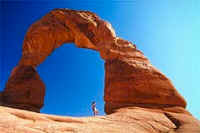 Arches contains one of the
largest concentrations of natural sandstone arches in the
world. The arches and numerous other extraordinary geologic
features, such as spires, pinnacles, pedestals and balanced
rocks, are highlighted in striking foreground and background
views created by contrasting colors, landforms and textures.
With the addition of the Lost Spring Canyon area, the park is
76,519 acres in size. Arches contains one of the
largest concentrations of natural sandstone arches in the
world. The arches and numerous other extraordinary geologic
features, such as spires, pinnacles, pedestals and balanced
rocks, are highlighted in striking foreground and background
views created by contrasting colors, landforms and textures.
With the addition of the Lost Spring Canyon area, the park is
76,519 acres in size.
Arches National Park is open
year round. The majority of park visitors come March through
October, with lowest visitation in December and January. You
can enjoy sightseeing by personal car, hiking, biking
(established roads only), picnicking (3 designated picnic
areas in park), and camping.
Native Americans utilized the
area for thousands of years. Archaic people, and later
ancestral Puebloan, Fremont and Utes searched the arid desert
for game animals, wild plant foods and stone for tools and
weapons. They also left evidence of their passing on a few
pictograph and petroglyph panels. The first white explorers
came looking for wealth in the form of minerals. Ranchers
found wealth in the grasses for their cattle and sheep. John
Wesley Wolfe, a disabled Civil War veteran, and his son, Fred,
settled here in the late 1800s. A weathered log cabin, root
cellar and a corral remain as evidence of the primitive ranch
they operated for more than 20 years. A visit to Wolfe Ranch
is a walk into the past.
Paleo-Indians lived in the
lush canyons leading to the Green and Colorado rivers from
about 10,000 to 7,800 BC and might have been the earliest
people to see Arches. Although there is no evidence of
Paleo-Indian use in the park, their spear points and camps
have been found nearby.
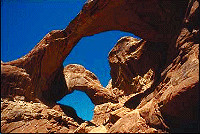 By 9,000 years ago, the climate
here became too warm and dry for many large mammals. They and
some of their Paleo-Indian hunters moved to higher habitats.
Those who stayed in the canyon country depended more on
gathering and traveling. This lifestyle, called Archaic, meant
that the people had to live in small groups and travel
extensively. Archaeologists have found a few spear points,
occasional campsites, and quarries for stone needed to make
tools. Barrier Canyon style rock art panels, once attributed
to the more recent Fremont culture, are the best evidence of
the Archaic hunter-gathers in Arches. By 9,000 years ago, the climate
here became too warm and dry for many large mammals. They and
some of their Paleo-Indian hunters moved to higher habitats.
Those who stayed in the canyon country depended more on
gathering and traveling. This lifestyle, called Archaic, meant
that the people had to live in small groups and travel
extensively. Archaeologists have found a few spear points,
occasional campsites, and quarries for stone needed to make
tools. Barrier Canyon style rock art panels, once attributed
to the more recent Fremont culture, are the best evidence of
the Archaic hunter-gathers in Arches.
By A.D.1, Archaic culture
gave way to prehistoric agriculturists called Ancestral
Puebloans, previously know as Anasazi and Fremont.
Arches National Park was a
frontier between these people. To the south, the Park
preserves some of the spectacular villages of the Ancestral
Puebloans at Mesa Verde, Chaco Canyon, Hovenweep and Navajo.
To the north at Dinosaur National Monument and to the west at
Capital Reef National Park, Fremont archaeological sites
dominate.
Ancestral Puebloan and
Fremont cultures were very similar. Only subtle difference in
styles of art and technological traits distinguish the two
cultures. Both groups supplemented their agricultural
economies with food from wild plants and animals, supported
large populations in sedentary village life, and made
beautiful black on white pottery.
Arches National Park was not
continuously occupied by these peoples. The landscape was only
marginally suitable for the floodwater farming these people
practiced.
During the thirteenth
century, both Ancestral Puebloan and Fremont peoples abandoned
the Arches region, drifted southward and were succeeded
through historic times by Utes and Paiutes. These people were
primarily hunters and gatherers.
No one knows who the first
European was to penetrate Arches. However in the mid 1800's
frontiers were pushed back and solitary mountain men and
trappers pursued big game and beaver in remote and hostile
territory. Denis Julien, one of those lone explorers, might
have been the first European to see Arches. He left his name
and the date, June 9, 1844, inscribed on a rock fin in the
park.
People from the Church of
Jesus Christ of Latter-day Saints established outposts in many
remote areas of Utah in the late 1800's Among these was Elk
Mountain Mission. In 1855 the missionaries, under the
impression that they were on friendly terms with the local Ute
Indians, planted crops and constructed a stone fort. But in
September of that year, Utes killed three of their settlers so
they quickly abandoned the out post and returned to their home
in northern Utah. It was 20 more years before another
settlement was attempted in Moab Valley.
In 1888 the first family of
settlers chose to settle in Arches. John Wesley Wolfe and his
son Fred moved from Ohio. They selected a 150 acre tract along
salt Wash for their Bar DX Ranch. Salt Wash provided the water
and the surrounding land had enough grass for a few cows. John
and Fred lived this solitary life for nearly 20 years. In
1907, John's daughter Flora, her husband Ed Stanley and their
two children moved to the ranch. They built a new cabin and a
root cellar, those seen in the park today. John's original
cabin was swept away by a flash flood. In 1910, the Wolfe
family moved back to Ohio. They sold the ranch to Tommy
Larson. Larson sold it to Mary Turnbow in 1914. Emmit Elizondo
bought it from Mary's heirs in 1947. The following year he
sold it to the federal government. In 1971 the site officially
became known as the Wolfe Ranch.
| 


